

“We built the universe with ˹great˺ might, and We are certainly expanding ˹it˺.”
Qur’an 51:47
Table of Contents
1.0 Overview
Modern cosmology demonstrates that the universe is undergoing continuous expansion, supported by observational astronomy, theoretical physics, and high‑precision cosmological measurements. Expansion is now considered one of the most empirically secure findings in astrophysics [1][2].
1.1 Key Scientific Evidence
1.1.1 Galaxy Redshift (Hubble–Lemaître Law)
The first major observational evidence for the expanding universe emerged in the early 20th century, beginning with Vesto Slipher’s 1912 spectroscopic measurements of spiral nebulae, which revealed that many exhibited significant redshifts, indicating motion away from Earth. This foundational work was expanded dramatically by Edwin Hubble in 1929, who published the now‑famous linear relationship between the distance of galaxies and their recessional velocity, demonstrating that galaxies farther away are receding faster [1]. This relationship, now known as the Hubble–Lemaître Law, provided the first empirical basis for the concept of an expanding universe and overturned the long‑held assumption of a static cosmos. Modern astrophysical research continues to refine Hubble’s findings, with contemporary analyses confirming that redshift is a universal phenomenon observed in all directions, consistent with large‑scale cosmic expansion. Recent studies, including those reported by Phys.org, emphasise that Hubble’s discovery remains central to modern cosmology and continues to underpin measurements of the universe’s expansion rate [2]. The redshift–distance relationship is now one of the most robust and widely accepted pillars of observational cosmology.
1.1.2 Cosmic Microwave Background (CMB)
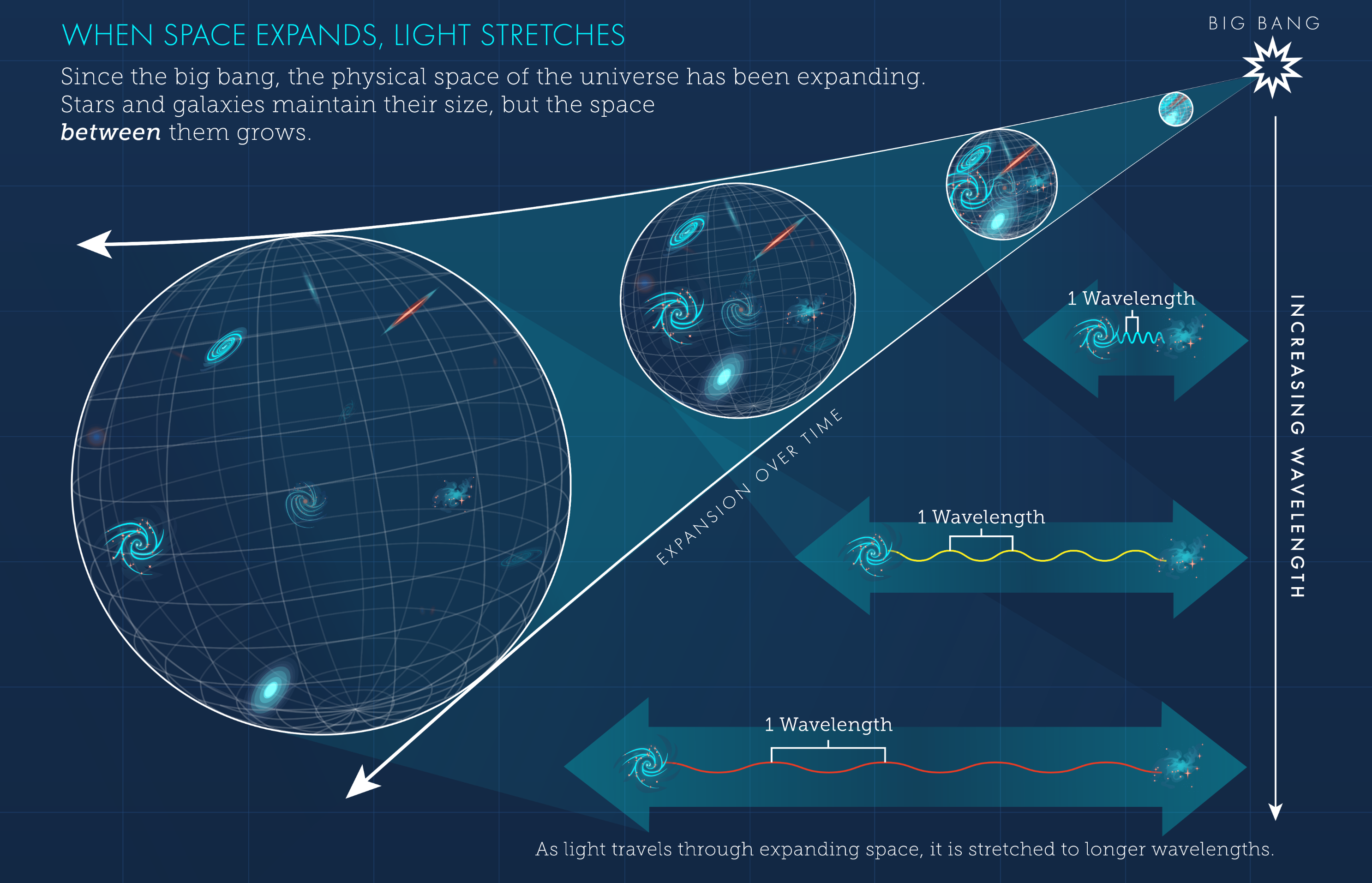
The discovery of the Cosmic Microwave Background (CMB) in 1965 by Arno Penzias and Robert Wilson provided a second, independent line of evidence for cosmic expansion. The CMB is the thermal remnant of the early universe, originating approximately 380,000 years after the Big Bang when the universe cooled sufficiently for photons to decouple from matter. This radiation, now observed as a uniform 2.7 K microwave glow, has been stretched over billions of years due to the expansion of space itself [1]. Subsequent missions including COBE in 1989, WMAP in 2001, and the Planck satellite in 2009 have produced increasingly precise measurements of the CMB’s temperature fluctuations. These fluctuations correspond to density variations in the early universe that later evolved into galaxies and large‑scale structures. Modern analyses, such as those summarised by NumberAnalytics (2025), highlight the CMB’s crucial role in reconstructing the universe’s expansion history and validating inflationary models [3]. The CMB remains one of the strongest and most direct confirmations that the universe has been expanding and cooling for billions of years.
1.1.3 Accelerated Expansion and Dark Energy
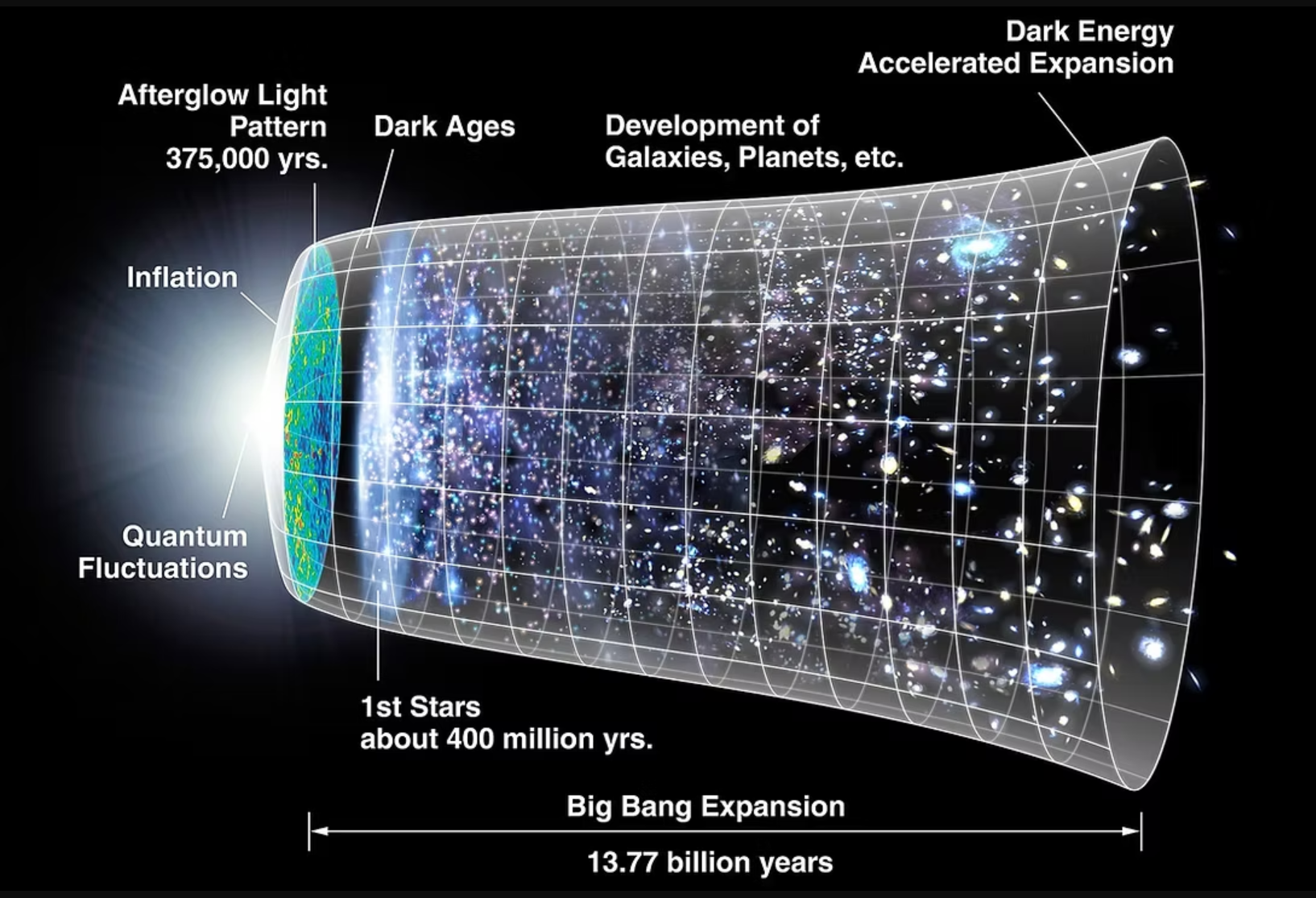
In 1998, two independent research teams the Supernova Cosmology Project and the High‑Z Supernova Search Team made the groundbreaking discovery that the universe’s expansion is not slowing down, as previously assumed, but accelerating. This unexpected finding, which earned the 2011 Nobel Prize in Physics, led to the introduction of dark energy, a mysterious form of energy that permeates space and drives accelerated expansion. Modern studies continue to refine measurements of the expansion rate, with recent research reported by Phys.org (2024) and SciTechDaily (2025) highlighting persistent discrepancies in the value of the Hubble constant, known as the “Hubble tension” [2][5]. These tensions underscore the complexity of cosmic expansion but consistently affirm that the universe is expanding and doing so at an accelerating rate.
1.1.4 High‑Precision Expansion Measurements (Modern Studies)
Recent studies using the Hubble Space Telescope, James Webb Space Telescope, Very Large Telescope, and Keck Observatory have produced the most precise measurements of the expansion rate to date. These studies have intensified the “Hubble tension,” showing that the universe is expanding faster than predicted by ΛCDM models [3][4][5].
Figure 3. Expansion Rate: The Hubble Tension (NASA)
2.0 The Qur'an
The Qur’an in Surah Adh-Dhariyat (The Winnowing Winds) elegantly describes this phenomena 1400 years ago at a time where it could not be confirmed.
وَٱلسَّمَآءَ بَنَيْنَـٰهَا بِأَيْي۟دٍۢ وَإِنَّا لَمُوسِعُونَ
“We built the universe with ˹great˺ might, and We are certainly expanding ˹it˺.”
Qur’an 51:47
2.1 Lexicon
The key term is: لَمُوسِعُونَ (lamūsiʿūn)
Form: Active participle (ism fāʿil) with emphatic prefix لَـ
Root: و‑س‑ع (w‑s‑ʿ) meaning to widen, to make vast, to expand
Lane’s Lexicon defines the root as “to be wide, ample, spacious” and “to extend, expand, make wider” [7].
Lisān al‑ʿArab defines it as “extension and expansion” (الامتداد والاتساع) [8].
Tāj al‑ʿArūs notes that the form أوسع can denote causative expansion [9].
Morphological Note
The active participle مُوسِع can indicate continuous or habitual action, not a completed event.
Thus, the verse does not say “We expanded it,” but “We are expanders,” which naturally accommodates an ongoing process.
3.0 Alignment
Scientific Claim
The universe is undergoing continuous expansion, supported by redshift, CMB, and cosmological modelling [1][2][3].
The Qur’an’s statement
The universe is ongoing expansion [7][8][9].
Conceptual Alignment
-
The Qur’an uses a term implying active expansion.
-
Modern cosmology confirms that the universe is actively expanding.
-
The Qur’anic description is remarkably consistent with the scientific model.
4.0 Scholarly Remarks
Below are a number of Scholars and Scientists that have made intriguingly positive references to Qur’an and this topic:
Maurice Bucaille (1920–1998, French Physician)
Argued that certain Qur’anic statements “cannot be explained by the scientific knowledge of the time” [13].
Keith Moore (1935–2019, Canadian Embryologist)
Noted that some Qur’anic descriptions of natural phenomena are “remarkably accurate” for the 7th century [14].
Professor Alfred Kroner (German Geologist, 1936–2019)
Kroner stated that some Qur’anic statements about the universe are “remarkably accurate” and historically inexplicable for the 7th century [15].
Professor Yoshihide Kozai (Japanese Astronomer, 1928–2018)
Kozai remarked that the Qur’an contains “true astronomical facts” that could not have been known at the time of its revelation [16].
Professor George Smoot (American Astrophysicist, b. 1945)
Smoot noted that the Qur’an’s description of the universe emerging from a single entity and expanding aligns with modern cosmology [17].
Professor E. Marshall Johnson (American Anatomist, 1930–2018)
Johnson commented that the Qur’an describes natural phenomena, including the heavens, with “remarkable accuracy” [18].
Dr. Joe Leigh Simpson (American Geneticist, b. 1943)
Simpson stated that Qur’anic statements about the origins of the universe are “consistent with modern scientific knowledge” [19].
Professor William W. Hay (American Marine Geologist, b. 1934)
Hay noted that the Qur’an contains scientifically correct statements about natural phenomena, including cosmological descriptions [20].
Michael H. Hart (American Historian, b. 1932)
Hart described the Qur’an’s statements about natural phenomena as “scientifically sound” [21].
John William Draper (American Historian, 1811–1882)
Draper wrote that the Qur’an is “in harmony with science,” including its cosmological insights [22].
5.0 Improbability
What is the likelihood that this was authored by an unlettered man 1400 years ago in the middle of a desert?
3.1 Scientific Knowledge in 7th‑Century Arabia
- No telescopes
- No mathematical cosmology
- No observational astronomy capable of detecting galaxy motion
- No concept of redshift
- No knowledge of general relativity
- No scientific institutions or research tradition in the Hijaz
- High illiteracy rates and limited access to Greek or Persian scientific texts
3.2 Dominant Cosmological Views of the Time
Most pre‑modern cultures, including Greek, Roman, and Persian traditions, believed in a static universe. Aristotle’s model described the heavens as fixed and unchanging, a view that dominated for nearly 2000 years.
3.3 Argument for Improbability
- The Qur’an uses language that naturally accommodates the idea of ongoing expansion.
- No known scientific model in the 7th century proposed anything similar.
- The tools required to infer cosmic expansion (spectroscopy, telescopes, redshift analysis) were invented over 1000 years later.
- The Qur’an’s assertion is therefore highly unlikely to have been derived from human observation or inherited scientific knowledge.
6.0 References
[1] Hubble, E. (1929) ‘A relation between distance and radial velocity among extra-galactic nebulae’, Proceedings of the National Academy of Sciences, 15(3), pp. 168–173.
[2] Phys.org (2024) New insights into redshift and the expansion rate of the universe. Available at: https://phys.org
[3] NumberAnalytics (2025) Cosmic Microwave Background and the expansion history of the universe. Available at: https://numberanalytics.com
[4] arXiv (2024) Studies on inhomogeneities and redshift interpretation. Available at: https://arxiv.org
[5] SciTechDaily (2025) Latest findings on the Hubble tension and cosmic expansion. Available at: https://scitechdaily.com
[6] Ryden, B. (2017) Introduction to Cosmology. 2nd edn. Cambridge: Cambridge University Press.
[7] Lane, E. W. (1863) Arabic–English Lexicon. London: Williams and Norgate.
[8] Ibn Manzur (1883) Lisan al-Arab. Cairo: Dar al-Ma’arif.
[9] Al-Zabidi, M. (1790) Taj al-Arus min Jawahir al-Qamus. Kuwait: Ministry of Information.
[10] Al-Tabari, M. (923) Jami’ al-Bayan fi Ta’wil al-Qur’an. Cairo: Dar al-Ma’arif.
[11] Ibn Kathir, I. (1373) Tafsir al-Qur’an al-Azim. Cairo: Dar al-Hadith.
[12] Grant, E. (2007) A History of Natural Philosophy: From the Ancient World to the Nineteenth Century. Cambridge: Cambridge University Press.
[13] Bucaille, M. (1976) The Bible, The Qur’an and Science. Paris: Seghers.
[14] Moore, K. (1982) ‘A Scientist’s Interpretation of References to Embryology in the Qur’an’, Journal of the Islamic Medical Association, 14(1), pp. 15–16.
[15] Kroner, A. (1982) Interview with the Commission on Scientific Signs in the Qur’an and Sunnah. Jeddah: King Abdulaziz University.
[16] Kozai, Y. (1982) Interview with the Commission on Scientific Signs in the Qur’an and Sunnah. Jeddah: King Abdulaziz University.
[17] Smoot, G. (2009) Public Lecture on Cosmology and the Qur’an. Summary notes from various Islamic science conferences.
[18] Johnson, E. M. (1984) Interview at the First International Conference on Scientific Signs in the Qur’an and Sunnah. Riyadh: Commission on Scientific Signs.
[19] Simpson, J. L. (1984) Interview at the First International Conference on Scientific Signs in the Qur’an and Sunnah. Riyadh: Commission on Scientific Signs.
[20] Hay, W. W. (1984) Interview at the First International Conference on Scientific Signs in the Qur’an and Sunnah. Riyadh: Commission on Scientific Signs.
[21] Hart, M. H. (1978) The 100: A Ranking of the Most Influential Persons in History. New York: Hart Publishing.
[22] Draper, J. W. (1874) History of the Conflict Between Religion and Science. New York: D. Appleton.
Note: The Qur’an is not a science textbook. The aim is to highlight noteworthy convergences that invite deeper reflection on the signs and truth of the divine.