

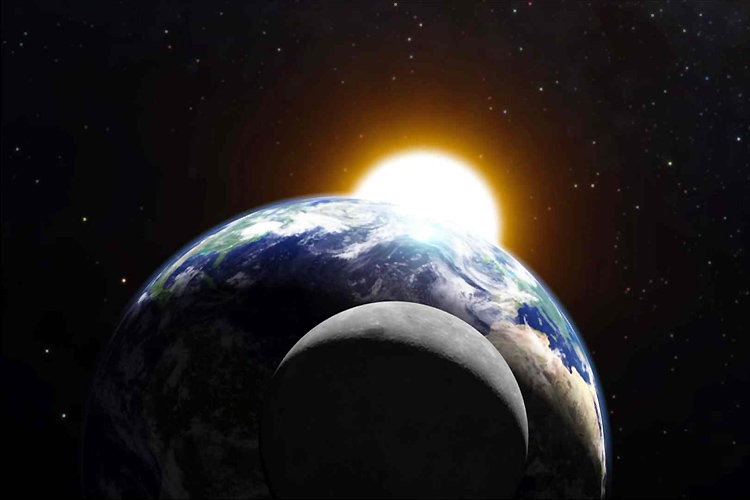
“The Sun is not permitted to catch up with the Moon, nor does the night outstrip the day. Each is swimming in an orbit.”
Qur’an 36:40
Table of Contents
1.0 Overview
Modern astronomy demonstrates that celestial bodies, including the Sun and the Moon, move continuously in precise, predictable orbits governed by gravitational dynamics. The Sun orbits the centre of the Milky Way galaxy, while the Moon orbits the Earth, and the Earth itself orbits the Sun. These motions are essential for the stability of the solar system, the regulation of seasons, tides, and climate, and the long‑term evolution of planetary systems. Contemporary astrophysics confirms that none of these bodies are stationary; rather, they follow defined paths determined by gravitational interactions and angular momentum [1][2][3].
1.1 Key Scientific Evidence
1.1.1 The Moon’s Orbit Around the Earth
The Moon orbits the Earth in an elliptical path with an average distance of 384,400 km. This orbital motion is responsible for the lunar phases, eclipses, and tidal forces. High‑precision laser ranging experiments confirm that the Moon is gradually moving away from Earth at a rate of approximately 3.8 cm per year due to tidal interactions [1]. The Moon’s orbital period is 27.3 days (sidereal month), and its motion is essential for stabilising Earth’s axial tilt and climate.
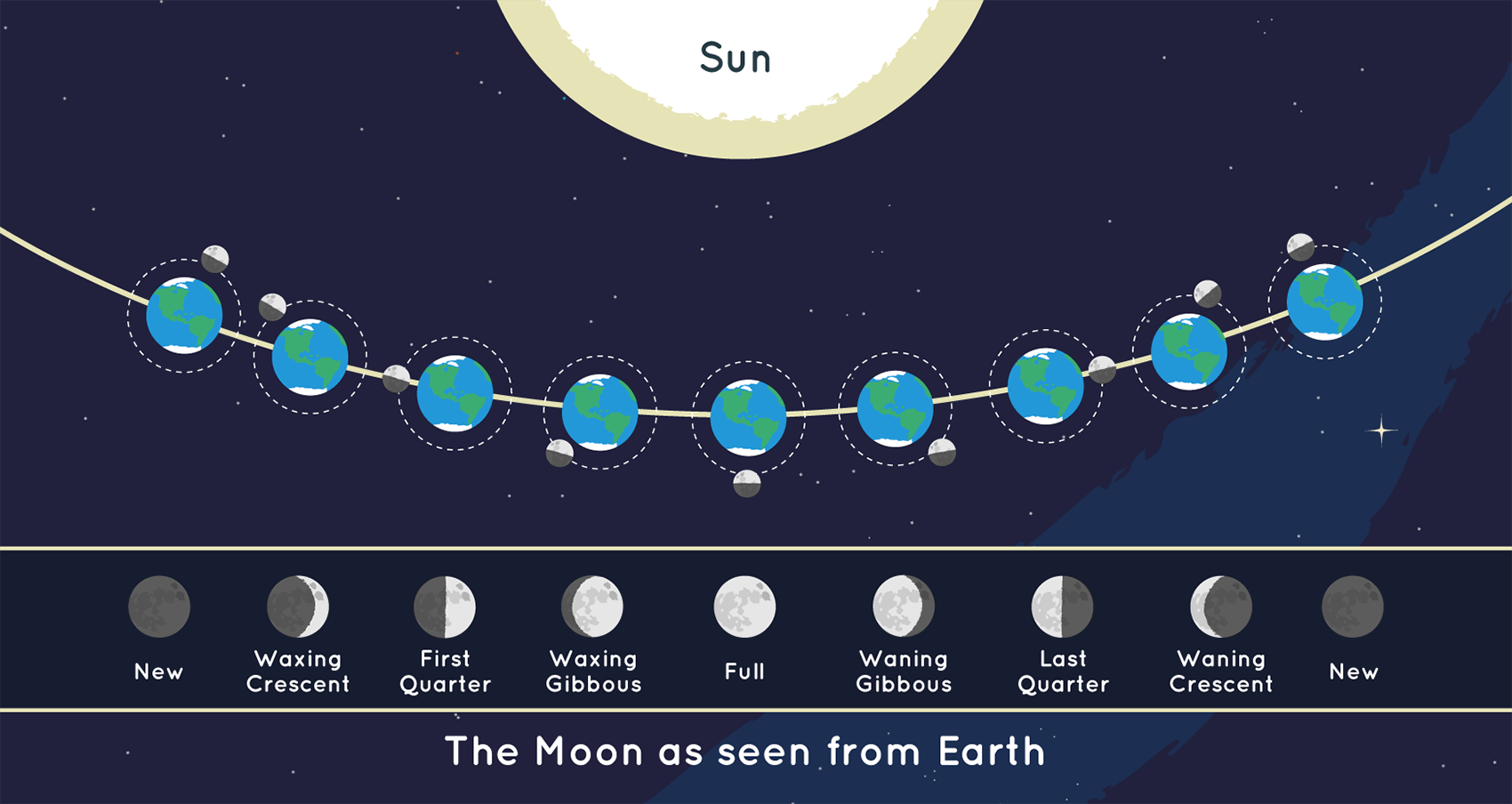
Figure 2. Visualisation of Moon orbit around Earth (NASA)
1.1.2 The Earth’s Orbit Around the Sun
The Earth orbits the Sun at an average distance of 149.6 million km, completing one revolution every 365.25 days. This orbital motion produces the seasons, regulates global climate patterns, and maintains the conditions necessary for life. The Earth’s orbit is governed by Newtonian gravitational dynamics and refined by general relativity, which accounts for small perturbations such as the precession of perihelion [2].
1.1.3 The Sun’s Orbit Around the Galactic Centre
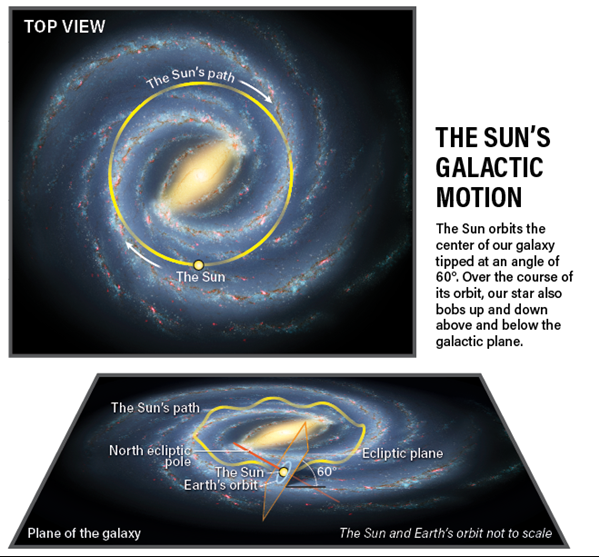
This is significant, contrary to ancient belief that the Sun is stationary, modern astronomy only recently shows that the Sun actually orbits the centre of the Milky Way galaxy at a speed of approximately 220 km/s. It completes one galactic orbit roughly every 225–250 million years, known as a “galactic year” [3]. This motion is essential for understanding stellar evolution, galactic dynamics, and the structure of the Milky Way.
1.1.4 Independent Orbits and Gravitational Harmony
Modern astrophysics emphasises that celestial bodies follow distinct orbits determined by mass, velocity, and gravitational interaction. The Sun, Moon, and Earth each have their own paths, yet their motions are harmonised through gravitational laws. This dynamic system ensures long‑term stability and prevents collisions or chaotic motion [2][3].
Figure 4. The motion of our Solar System
2.0 The Qur'an
The Qur’an explicitly states that the Sun and the Moon move in precise, ordained paths.
وَالشَّمْسُ تَجْرِي لِمُسْتَقَرٍّ لَّهَا
“And the Sun runs on its course to a determined place.”
Qur’an 36:38وَالْقَمَرَ قَدَّرْنَاهُ مَنَازِلَ
“And the Moon — We have determined for it phases.”
Qur’an 36:39لَا الشَّمْسُ يَنبَغِي لَهَا أَن تُدْرِكَ الْقَمَرَ وَلَا اللَّيْلُ سَابِقُ النَّهَارِ ۚ وَكُلٌّ فِي فَلَكٍ يَسْبَحُونَ
“The Sun is not permitted to catch up with the Moon, nor does the night outstrip the day. Each is swimming in an orbit.”
Qur’an 36:40
These verses describe continuous motion, distinct orbits, and a harmonious celestial system.
2.1 Lexicon
Key Terms
يَسْبَحُونَ (yasbaḥūn) — “they swim, move smoothly, glide” Lane’s Lexicon (1863) defines sabaḥa as moving swiftly in a fluid‑like manner, indicating continuous motion [4].
فَلَك (falak) — “orbit, rounded path, celestial track” Lisān al‑Arab (1290–1311 CE) defines falak as a circular or rounded course in which celestial bodies move [5]. Tāj al‑‘Arūs (c. 1760–1790 CE) emphasises that falak refers to a fixed, ordained path [6].
Morphological Note
The phrase يَسْبَحُونَ (yasbaḥūn) is a present tense plural verb in the imperfect form, indicating continuous, ongoing action. This morphology conveys uninterrupted motion.
2.2 Early Exegesis
Al‑Tabari (d. 923 CE)
Al‑Tabari explains that “kullun fī falakin yasbaḥūn” means that the Sun, Moon, and stars move in continuous motion within their own orbits.
كُلٌّ يَجْرِي فِي مَجْرًى وَمَسِيرٍ لَهُ
“Each runs in a course and path appointed for it.” [7]
Ibn Kathir (d. 1373 CE)
Ibn Kathir states that the Sun and Moon move in precise orbits, never colliding or overtaking one another.
يَدُورُونَ فِي مَدَارَاتِهِمْ لَا يَخْتَلِطُونَ وَلَا يَصْطَدِمُونَ
“They rotate in their orbits without mixing or colliding.” [8]
Al‑Qurtubi (d. 1273 CE)
يَسْبَحُونَ أَيْ يَجْرُونَ سَيْرًا سَلِسًا
“They move in a smooth, flowing motion.”
[9] Al‑Qurtubi emphasises that yasbaḥūn indicates smooth, continuous motion.
3.0 Alignment
Scientific Claim
The Sun moves in a galactic orbit.
The Moon orbits the Earth.
The Earth orbits the Sun.
Each body follows its own path.
None collide or overtake one another. [1][2][3]
The Qur’an’s Statement
The Sun runs its course.
The Moon has phases and a path.
Each moves in an orbit. [7][8][9][10]
Conceptual Alignment
Both describe continuous motion.
Both describe distinct orbits.
Both describe a harmonious system.
Both reject the idea of a stationary Sun.
The Motion Described as “Swimming”
The Qur’an describes the Sun, Moon, and celestial bodies as “swimming” in their orbits through the verb يَسْبَحُونَ (yasbaḥūn), a term that classical Arabic lexicons define as moving smoothly, gliding, or swimming in a fluid‑like manner [4][5][6]. This linguistic choice conveys continuous, frictionless, graceful motion—precisely the behaviour observed in orbital mechanics, where bodies move through the curvature of spacetime in smooth, uninterrupted paths [1][2][3].
Interestingly, the analogy of “swimming” also appears in contemporary space science. Astronauts are required to learn how to swim and train extensively in NASA’s Neutral Buoyancy Laboratory, where underwater movement simulates the frictionless, inertia‑driven environment of microgravity [23]. Astronauts frequently describe their motion in orbit as “floating,” “gliding,” or “swimming” through space, reflecting the same fluid‑like dynamics expressed by the Qur’anic verb yasbaḥūn [24].
This makes the Qur’anic description not only poetically vivid but also scientifically intuitive in a way that was entirely absent from the cosmological models of the 7th century.
4.0 Scholarly Remarks
Alfred Kroner (German Geologist)
Described Qur’anic cosmological statements as “remarkably accurate” [15].
Yoshihide Kozai (Japanese Astronomer)
Said the Qur’an contains “true astronomical facts” unknown in the 7th century [16].
George Smoot (Nobel Prize Astrophysicist)
Noted that the Qur’an’s description of cosmic motion aligns with modern cosmology [17].
E. Marshall Johnson (American Scientist)
Commented that the Qur’an describes natural phenomena with “remarkable accuracy” [18].
Joe Leigh Simpson (American Geneticist)
Said Qur’anic statements about the universe are “consistent with modern scientific knowledge” [19].
William Hay (American Scientist)
Acknowledged scientifically correct cosmological descriptions in the Qur’an [20].
Michael Hart (American Historian)
Described Qur’anic statements as “scientifically sound” [21].
John William Draper (Historian of Science)
Wrote that the Qur’an is “in harmony with science” [22].
5.0 Improbability
What is the likelihood that this was authored by an unlettered man 1400 years ago in the middle of a desert?
5.1 Scientific Knowledge in 7th‑Century Arabia
- No concept of orbital mechanics
- No telescopes or astronomical instruments
- No knowledge of the Sun’s galactic motion
- No understanding of gravitational dynamics
- No scientific institutions or observational astronomy tradition in the Hijaz
5.2 Dominant Cosmological Views of the Time
- Greek and Roman models assumed a stationary Earth
- Ptolemaic cosmology dominated, with celestial spheres
- The Sun was believed to be fixed in place
- No civilisation proposed the Sun’s motion around the galaxy
- No ancient model described all bodies moving in independent orbits
5.3 Argument for Improbability
The Qur’an describes continuous motion of the Sun and Moon
It states that each moves in its own orbit
It rejects collision or overtaking
These concepts align with modern astrophysics
No known scientific model in the 7th century proposed anything similar
The Qur’an’s description is therefore historically unexpected and highly improbable to have been derived from human observation.
6.0 References
[1] NASA (2023) Lunar Laser Ranging Experiments.
[2] NASA / JPL (2023) Earth’s Orbit and Solar Dynamics.
[3] ESA Gaia Mission (2022) Galactic Motion of the Sun.
[4] Lane, E. W. (1863) Arabic–English Lexicon.
[5] Ibn Manzur (1290–1311 CE; printed 1883) Lisān al‑Arab.
[6] Al‑Zabidi (c. 1760–1790 CE) Tāj al‑‘Arūs.
[7] Al‑Tabari (d. 923 CE) Jāmiʿ al‑Bayān.
[8] Ibn Kathir (d. 1373 CE) Tafsīr al‑Qur’ān al‑ʿAẓīm.
[9] Al‑Qurtubi (d. 1273 CE) Al‑Jāmiʿ li‑Aḥkām al‑Qur’ān.
[10] Ibn ‘Ashur (d. 1973 CE) Al‑Taḥrīr wa al‑Tanwīr.
[11] Bucaille, M. (1976) The Bible, The Qur’an and Science.
[12] Moore, K. (1982) Journal of the Islamic Medical Association.
[13] Guessoum, N. (2011) Islam’s Quantum Question: Reconciling Muslim Tradition and Modern Science. London: I.B. Tauris.
[14] Hoodbhoy, P. (1992) Islam and Science: Religious Orthodoxy and the Battle for Rationality. London: Zed Books.
[15] Kroner, A. (1982) Interview with the Commission on Scientific Signs.
[16] Kozai, Y. (1982) Interview with the Commission on Scientific Signs.
[17] Smoot, G. (2009) Public Lecture on Cosmology and the Qur’an.
[18] Johnson, E. M. (1984) Interview at the First International Conference on Scientific Signs.
[19] Simpson, J. L. (1984) Interview at the First International Conference on Scientific Signs.
[20] Hay, W. W. (1984) Interview at the First International Conference on Scientific Signs.
[21] Hart, M. H. (1978) The 100.
[22] Draper, J. W. (1874) History of the Conflict Between Religion and Science
[23] NASA (2020) Neutral Buoyancy Laboratory Overview. NASA Johnson Space Center, Houston.
[24] Massimino, M. (2016) Spaceman: An Astronaut’s Unlikely Journey to Unlock the Secrets of the Universe. New York: Crown Publishing.
Note: The Qur’an is not a science textbook. The aim is to highlight noteworthy convergences that invite deeper reflection on the signs and truth of the divine.